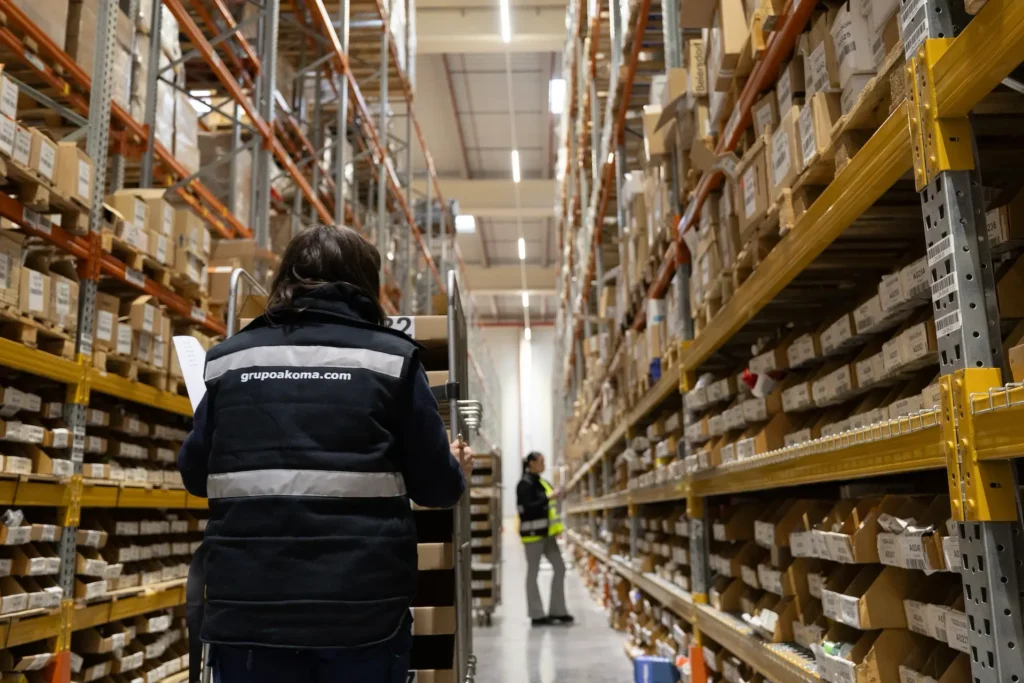
If you are selling more and more but feel less and less control over your operation, the problem is not commercial. It's logistical. And it's not solved with patches: it's solved with a system that's ready to grow with you.
When an ecommerce business grows from dozens to hundreds of orders per day, logistics is no longer a chore and becomes the backbone of the business. If that backbone doesn't hold up, everything else suffers: delivery times, customer experience, margin and the ability to launch campaigns without fear.
This content is designed for ecommerce managers who:
- They handle tens to hundreds of orders a day.
- They feel that growth generates more chaos than good.
- They depend too much on individuals and too little on processes.
- They need to understand what options they have before making a decision.
Here you will find a complete overview of what fulfilment entails, how to compare logistics models, what indicators to demand, how returns are handled and how to assess whether an operator can really sustain your growth.
What is eCommerce fulfilment and what does it really include?
Fulfillment is not synonymous with shipping orders. It is the complete system that transforms an online sale into a successful delivery and, when there is a return, retrieves that product to make it available again.
When someone buys from your shop, they don't just buy a product. They buy an experience that depends on your entire chain working precisely: from the time the goods enter the warehouse until the customer receives them and, if they need to return them, until that unit is returned to your inventory.
Understanding this changes the way you analyse your logistics. It is no longer an operational task but a business-critical infrastructure.
Stages of the fulfilment process
Each phase of fulfilment has a direct impact on the customer experience and your profitability. When one fails, the consequences ripple through the rest.
Reception and storage
This is where it all begins. Every unit that arrives must be correctly recorded, placed in position and reflected in the system. If there are errors at this stage, you sell products that do not physically exist, you think you have stock that you don't, or you discover discrepancies when it is too late.
A common example: you receive 1,000 units but the system registers 970 units. When you sell the last ones, your shop will still show availability and the orders you can't serve will start.
Picking and packing
This is the phase where most errors occur in manual operations. Picking means locating the exact product in the warehouse. Packing means preparing it correctly for shipment: packaging, documentation, labelling.
Without a guided system, the most costly mistakes appear: wrong size, wrong product, incomplete or duplicate order. Each error means additional shipping costs, incident management, possible returns and loss of confidence.
Shipping and tracking
Once the order is prepared, factors that many ecommerce companies underestimate come into play: the choice of carrier based on destination and cost, label generation, status synchronisation with the customer and shipment visibility.
If the buyer does not have clear information about where their package is, contact support. Every ticket is time and cost that you could be spending on growth.
Returns and disposal
Reverse logistics is not an add-on. It is a structural part of today's ecommerce. You need to be able to respond quickly if the product is in good condition, if it can be resold, if it needs to be reconditioned or if it should be discarded.
Without a clear process, inventory becomes cluttered and margin deteriorates unnoticed until it becomes a serious problem.
Signs that you should outsource fulfilment
You don't need more tools when the problem is structural. You need a change of model when volume, returns and spikes start to overwhelm your operations.
Many ecommerce managers try to solve the chaos by adding additional applications, spreadsheets or manual processes. This tends to make the situation worse: each new layer adds friction and multiplies points of failure. Outsourcing is not a decision based on intuition. It is a decision based on measurable symptoms.
Operational diagnostic checklist
Think back over the last week and mark how many of these situations you recognise:
- The stock in the system does not match the physical stock.
- Your team reviews orders manually before sending them out
- You have sent wrong orders in the last few days
- Returns force you to rework inventories
- You do not know the actual cost per order prepared
- Customer service receives daily questions about shipments
- You delay campaigns because you fear you can't manage the volume.
- When there are peaks, the equipment goes into emergency mode.
- Control depends on individuals, not processes.
- You have had to improvise space to store products
Interpretation:
| Signals detected | Diagnosis |
|---|---|
| 0-2 | Stable operations |
| 3-5 | Structural friction |
| 6-8 | Light bottleneck |
| 9-10 | Saturated system |
If you are in the middle or upper range, the problem is not punctual. It is systemic.
Turning point thresholds
There are metrics that indicate that an ecommerce is entering the logistics risk zone even if it does not yet perceive it:
- More than 50 constant orders per day
- Catalogue with more than 200 references
- Sales in more than one region or country
- Recurrent promotional campaigns
- Return rate above 10%
It is not necessary for all of them to be met. It is enough for several of them to coincide for the operation to start to become strained. The deterioration is progressive: first it takes longer to prepare orders, then incidents accumulate, then negative reviews arrive, and finally growth stagnates - not because of a lack of demand, but because the operation reaches its limit.
The mistake of waiting for collapse
The right time to evaluate a change is not when everything fails. It is when you start to notice that growth is too dependent on the manual capacity of your team.
Imagine you manage 80 orders a day without any problems. You launch a campaign and for three days you receive 300. If your system does not absorb that peak, delays, preparation errors, customers writing in and subsequent returns occur. The campaign works commercially, but the operational experience breaks down. Your marketing is growing faster than your logistics.
Key question: If tomorrow your sales were to double for a week, would your current system support it without affecting deliveries and stock? If the answer is no, your limitation is not commercial. It is operational.
In-house vs 3PL vs FBA: a comparison to make an informed decision
How you manage your orders determines how much you can scale, how much margin you retain, how much control you have over your brand and how much operational risk you take. If you're considering a change, you're probably comparing three models: continue to manage in-house, delegate to Amazon FBA or work with a specialised 3PL.
In-house logistics
It is the model most people start with. It makes sense at first: it is flexible, it offers direct physical control and the costs seem low. But that «seem» is important.
Advantages: direct stock control, immediate decisions, no external dependence.
Limitations: poor scale with volume, high dependency on people, frequent manual errors, unaccounted hidden costs (space, staff, peak overtime) and operational risk in campaigns.
If you are handling 70 orders a day today and tomorrow you go up to 200 during a campaign, can you absorb it without hiring, training and reorganising in days? If the answer is no, your in-house model has a ceiling.
Amazon FBA
FBA is powerful if your primary channel is Amazon. The infrastructure is solid and the logistics are solved within that ecosystem.
Advantages: massive infrastructure, speed within Amazon, fully integrated operation in the marketplace.
Limitations: channel dependency, partial loss of brand experience, less control over the end customer and difficulty if you sell outside Amazon. If your strategy is own brand DTC with strong identity, careful packaging and data control, FBA may not align with your positioning.
3PL specialised in ecommerce
Operators designed for brands that want to grow without losing control. They connect systems, automate flows and reduce manual intervention.
Advantages: escalabilidad estructural, integraciones con tienda y ERP, control de stock en tiempo real, gestión profesional de devoluciones, capacidad para operar en España y Europa, adaptación a B2C y B2B. Así lo aplicamos en nuestro fulfillment 3PL en España.
A 3PL does not only prepare orders. It changes the operational structure of the business.
Comparison by strategic criteria
| Criterion | In-house | FBA | Specialised 3PL |
|---|---|---|---|
| Scalability | Limited | Registration on Amazon | Multi-channel discharge |
| Brand control | High | Medium | High |
| Integrations | Manuals | Amazon Ecosystem | APIs and platforms |
| Returns management | Internal | Amazon Standard | Customisable |
| EU Expansion | Complex | Limited to the ecosystem | Structured |
| Dependency | Baja | High (Amazon) | Medium, but flexible |
The common mistake when comparing: many only look at the cost per shipment. That is incomplete. You must include cost per completed order, cost per error, cost per return, handling time, impact of failed campaigns and cost of lack of scalability. When you introduce those variables, the comparison changes dramatically.
The underlying question: do you want your competitive advantage to be packing boxes or outselling your competition?
How a modern 3PL works when everything is connected
An ecommerce-ready logistics operator is not defined by the size of the warehouse. It is defined by how information flows between systems. When a 3PL is well designed, it functions as an operational extension of your business: your shop, your inventory, your orders and your shipments are automatically coordinated.
Integrations that eliminate manual work
If your team is exporting orders, importing files or checking cross-platform matches by hand, your operation relies on repetitive tasks that don't scale and generate errors. A connected system eliminates that problem from the ground up.
When integrated directly with your ecommerce (Shopify, WooCommerce or other platforms), each order is entered automatically, stock is updated in real time, shipment status is synchronised with the customer and incidents are logged.
If you also work with ERP or marketplaces, integration via API ensures that all channels share data in real time: no out-of-sync stock, no duplicate orders, no update delays.
Operational flow of an order in a prepared system
In a modern 3PL, the complete order flow works like this:
- The customer buys in your shop
- The order automatically enters the logistics system
- Product location is assigned
- The operator receives guided instructions (system-directed picking).
- The product is validated before preparation
- The system generates the shipping label
- The optimal carrier is selected according to destination and cost.
- The order leaves the warehouse
- The customer receives updated tracking
- Stock is updated automatically
There are no intermediate manual steps or repetitive human validation. With guided picking, the system indicates the exact location and validates the product before confirming it, reducing errors before they become issues or returns.
Peak demand absorption
Peaks (campaigns, launches, Black Friday) are one of the biggest logistical risks. If your system is not prepared, the impact drags on for weeks.
An ecommerce-ready operator can temporarily expand capacity, reorganise resources, prioritise urgent orders and maintain stable picking times. The key is that the system is not designed for average volume, but for variations.
Example: if your usual volume is 120 orders per day and a campaign generates 600 over three days, a prepared system absorbs this as an expected variation, not a crisis.
Why technology matters more than square footage
It is common to evaluate suppliers by the size of their facilities. However, physical size does not predict performance. It is the combination of software, automation and processes that determines performance.
An operator with integrated technology handles more volume with less friction than one with larger facilities but manual processes. What matters is whether you have a centralised system that connects orders, inventory, shipments and returns in a single environment. When that technology layer is in place, operational control is no longer dependent on manual checks, but on real-time data.
Outsourcing should not mean losing visibility. It should mean gaining visibility: actual updated stock, status of each order, active incidents, preparation times and operational performance. You move from reacting to anticipating.
KPIs and SLAs you must demand to avoid returning to chaos
If you don't define metrics before hiring a logistics operator, you are not buying results. You are buying expectations. And expectations without metrics turn into frustration.
When you work with a 3PL, what you buy is not space or manpower. It's an operating system. And any operating system needs indicators that define whether it is working properly.
Logistics KPIs you need to know
A logistics KPI is not a decorative piece of data in a monthly report. It is a signal that allows you to detect deviations before the customer notices them.
Accuracy of preparation. The most critical indicator because it directly impacts returns, incidents and reputation. If an operator has an accuracy rate of 99.8%, it means that out of every thousand orders, two may contain errors. At high volumes, that difference translates into dozens of incidents per month.
Average preparation time. How long it takes for an order to be ready from the time it enters the system. Essential when working with campaigns or launches, because it determines whether you can keep promises of fast delivery without forcing the operation.
Exit time. How long it takes from the time the order is prepared until it leaves the warehouse. An efficient operator not only prepares quickly; he dispatches smoothly.
Percentage of incidents. No operation is perfect, but there is a huge difference between a system that minimises errors and one that constantly generates them.
Speed of reinstatement of returns. The time between a customer returning a product and that product becoming available for sale again. Critical for cash flow and inventory control.
SLAs: commitments that protect your operation
Service level agreements are not administrative clauses. They are measurable commitments that set out what performance you can demand and what happens if it is not met.
A well-defined SLA specifies maximum preparation times, accuracy levels, incident handling times and response procedures. When an operator works with clear SLAs, performance is not left to interpretation: it is fixed by contract.
A good SLA not only covers order fulfilment. It also includes returns management, inventory updating and incident resolution. If these processes are not covered, the operator can technically deliver on shipments while your operation is still struggling.
How to use KPIs to compare suppliers
Comparing operators is not about asking for tariffs and choosing the lowest one. It is about analysing what return you get for each euro invested.
When you ask for concrete metrics, you change the business conversation. The supplier moves from talking in generic terms to talking in operational terms. If he can clearly explain how he measures his accuracy, how he monitors times and how he detects deviations, he probably has a solid system. If you respond in generalities, your operation is likely to rely more on experience than on structured processes.
Choosing a supplier without defined KPIs is like hiring someone without defining their position. It may work for a while, but sooner or later friction will arise because no one has established what exactly it means to get it right.
Returns and reverse logistics: how to protect margin and reputation
Returns are one of the most delicate moments in the relationship between your brand and your customer. It is not a flaw in the commercial process: it is a natural part of ecommerce. And the more you sell, the more returns you will have.
If your operation is not prepared to handle them quickly and accurately, the impact is not only logistical. It is also financial and reputational.
Regulations and legal obligations
When you sell online in Spain or in the European Union, the right of withdrawal is part of the legal framework. The customer has a period of time to return a remotely purchased product without having to justify it, with conditions depending on the type of item.
This has a direct implication: it is not optional to have a returns process. It is mandatory, and it must work properly. If the process is slow or chaotic, stock no longer reflects reality, refunds are delayed, support increases and friction is generated. A poorly managed return can cost you more than the original sale.
Operational process for efficient returns
A professional reverse logistics system follows a clear sequence:
- Entry register of the package linked to the original order
- Inspection to check the status of the item
- Disposition decision: direct resale, reconditioning or discarding
- Automatic inventory update to avoid discrepancies between actual and digital stock
- Activation of the reimbursement flow or replacement
When this process is automated and documented, returns are no longer a problem and become a controlled part of the system.
Real impact on your margin and loyalty
Many ecommerce retailers calculate margins without taking returns into account. Each return has a compound cost: transportation, handling, inspection, inventory update and sometimes loss of product value. The difference between well-designed reverse logistics and improvised reverse logistics can mean several percentage points of annual margin.
In addition, the customer judges your brand when something does not go as expected. If the return process is clear, fast and transparent, trust increases. If it is confusing or slow, trust is lost. And in ecommerce, repeat purchases are one of the most profitable factors: a returning customer costs much less than a new one.
Signs that your returns system needs improvement: your team spends too much time tracking down individual returns, refunds are delayed because no one knows what condition the returned product is in, or inventory requires frequent manual adjustments. These symptoms indicate that the problem is not the volume of returns, but the absence of a clear operational flow.
How to assess whether an operator can sustain your growth
The difference between a logistics provider and an operational partner is not in what it promises. It is in what they can demonstrate.
When evaluating an operator to outsource your fulfilment, you should not focus on their sales pitch or their facilities. What you need to check is whether they have the infrastructure, technology and expertise to sustain your growth when volume increases, when there are issues and when peaks occur.
Operational evidence vs. commercial narrative
Many operators talk about speed, control or precision. But these concepts only have value when they are backed up by verifiable elements.
There are objective signs of a sound system:
- Process automation. When the operation relies on manual tasks, the margin of error grows with the volume. When flows are system-guided, accuracy remains stable even in high demand.
- Real-time traceability. If the operator can show where each unit is, what orders are in preparation and what returns are in process, the operation is structured around data, not estimates.
- Peak protocols. Spikes are a natural part of the ecommerce business cycle. If the operator does not have defined procedures to absorb them, any powerful campaign becomes a risk.
In Bolian's case, its operating environment includes automated systems capable of handling large daily unit volumes with consistent accuracy, without relying on linear increases in staffing levels as demand grows.
Indicators that an operator is ready to scale up
There is one question that reveals more than any commercial presentation: What happens if I triple orders during a campaign?
A solid answer should include: available operational capacity, degree of automation, peak protocols, guaranteed times and quality control. If the answer is ambiguous, you are not looking at a growth partner.
What to check before deciding
Before making a choice, the most useful thing to do is not to listen to a presentation. It is to see how the operation works. Being able to observe real processes, understand how orders are handled and see how performance is monitored gives a more accurate picture than any theoretical explanation.
Operators who offer site visits or demonstrations applied to real cases demonstrate transparency. This is usually a good sign, because it indicates that the system can be shown for what it is.
Frequently asked questions before outsourcing your fulfilment
What exactly does fulfilment with Bolian include?
The service covers the entire operational cycle of the order: receipt and storage of goods, preparation with guided picking, automatic generation of labels, optimised selection of carrier, shipment with tracking and complete returns management. All centralised in a system connected to your ecommerce.
How does Bolian integrate with my online shop?
Bolian works with direct integrations with platforms such as Shopify and WooCommerce, and allows connection via API with ERP and marketplaces. Orders are automatically entered into the logistics system, stock is synchronised in real time and shipping statuses are updated in your shop without manual intervention.
Do I lose visibility if I outsource to Bolian?
No. The opposite is often the case. Bolian operates proprietary software that centralises orders, inventory and returns, with access to real-time, up-to-date information. Control is no longer dependent on manual checks, but on structured data.
What about returns?
Reverse logistics is a structural part of the system. When a product is returned, it is recorded, evaluated and returned to the inventory according to a defined protocol. The update is carried out within the same environment that manages outgoing orders, avoiding stock mismatches. This is especially relevant in sectors such as cosmetics, parapharmacy or food, where traceability by batch and expiry date is critical.
Can Bolian handle both B2C and B2B?
Yes, the system handles both B2C unit orders and B2B shipments with boxes, pallets and specific documentation. If your business combines direct-to-consumer sales with distribution to retailers, both lines are managed within the same infrastructure.
Is it possible to operate in Spain and in the European Union with the same system?
Yes, Bolian operates 3PL fulfilment in Spain with 24/48 hour delivery and manages shipments to different EU countries from the same logistics system, maintaining unified traceability and control without fragmenting the operation by country.
How does Bolian manage peak demand?
The operation is designed to absorb volume variations thanks to automated infrastructure and guided processes. This allows operational stability to be maintained even in campaigns with sharp increases in orders, reducing the risk of errors and delays.
Which sectors have the best fit with Bolian?
He has particular expertise in cosmetics and beauty, parapharmacy, food, publishing, fashion and textile, and subscription models. In these sectors, traceability, inventory control and peak stability are particularly relevant.
How do I know if my ecommerce fits with Bolian?
If you manage tens to hundreds of orders per day, work with multiple references and want to scale without increasing internal structure, you will probably fit. The most direct way to check this is an analysis applied to your real case: volume, SKUs, target countries and current operating model.
Next step: how to get started without risk
You have come this far because your logistics are already generating friction or you know they will as you continue to grow. The question is no longer what is fulfilment. It's whether your current system is ready for the next level.
What you need to be clear about before contracting
Before choosing a 3PL - even before choosing Bolian - you should be able to answer with numbers:
- How many orders do you actually handle per day and per peak?
- What percentage of returns impacts on your stock
- How much time your team spends on logistical tasks
- How much each operational error costs you
If you cannot respond with data, you are operating without full visibility. And lack of visibility leads to reactive decisions.
Getting started with Bolian
The process does not start with a contract. It starts with a diagnostic: review your volume, your SKUs, your target countries and your current model to understand if the structure is a good fit for you.
From there, real cost per volume can be estimated, growth scenarios can be simulated, the operational transition can be assessed and an implementation plan can be defined. If the fit is right, the change is not abrupt: clear phases of integration, stock dispatch, operational testing, flow validation and controlled start-up are defined.
The aim is that the transition should not generate additional friction. On the contrary: it should progressively reduce it.
The real decision you are making
You are not deciding whether or not to outsource. You are deciding whether your current structure can sustain the growth you seek.
If your ambition is to grow in Spain and operate in the European Union with stability, you need an infrastructure that does not depend on improvisation. Bolian is not simply a warehouse that prepares orders. It's a system designed to centralise inventory, integrate platforms, absorb peaks and manage returns without breaking your operation.